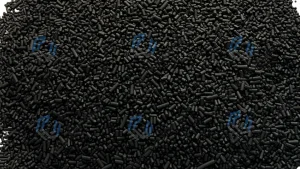
Optimizing Linde PSA Nitrogen with SorbiTech CMS
If your PSA nitrogen generator was commissioned with Linde LMC media, the bed inside it is a Carbon Molecular Sieve, and it is the part that actually separates the gas. SorbiTech supplies Carbon Molecular Sieve for units built around LMC 15 H, 20 H, 20 S and 15 P, as a refill when the existing bed reaches the end of its service life and as an alternative supply when lead time or cost is the constraint.
The point worth holding on to is that the model number on the original fill describes a duty, not a secret. A bed is specified by the purity the plant needs, the volume of gas it moves and the condition of the air reaching it. Those are the inputs we work from, and they are the inputs that decide whether a replacement performs.
Where the Adsorbent Sits in an LMC Unit
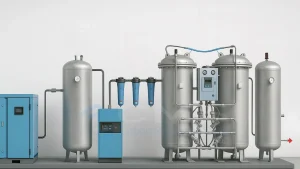
Air entering a pressure swing adsorption generator is mostly nitrogen and oxygen, close enough in size that neither can be filtered out. The carbon separates them by rate of entry. Its pore openings are sized so that oxygen travels into the structure considerably faster than nitrogen, so over the short interval the bed is held under pressure the gas leaving the vessel is nitrogen enriched. Dropping the pressure vents the adsorbed oxygen and readies the bed for the next charge of air.
Everything upstream of the vessels exists to protect that bed. Filtration and drying remove oil, water and particulate before they reach the carbon, because contamination that gets into the pore structure is not something the cycle can purge. When an LMC bed underperforms, the air treatment ahead of it is worth checking before the carbon is blamed.
Matching a SorbiTech Grade to an LMC Duty
Grade selection follows from two inputs, the purity the least tolerant process on the site requires and the volume of gas the plant consumes. A unit feeding general blanketing and purging is served by a grade chosen for throughput, where the economics favour moving a large volume efficiently, and CMS 260L and CMS 350KT sit at that end of the range. A unit feeding a process judged on surface quality works at the other end and needs a grade developed for the tighter duty, which is where CMS 450HP sits, while a duty led by volume but carrying a tighter floor than blanketing is generally better matched by CMS 420KT.
We do not publish a line by line swap table against LMC model numbers, because a table like that hides the thing that matters. Two plants running the same original grade can need different replacements once their actual duty, air supply and vessel dimensions are on the table. The LMC equivalence page sets out how we approach that comparison, and the grade range shows what each one is built for.
Adsorbent Condition Decides Nitrogen Purity
A bed in good condition holds its working capacity cycle after cycle, and the generator holds purity without being driven harder. As capacity falls the control system compensates by extending cycles or raising air consumption, and the cost of that shows up on the compressed air bill long before anyone connects it to the adsorbent. Compressed air is the real operating cost of on site generation, so a bed quietly losing capacity is an expense, not just a performance issue.
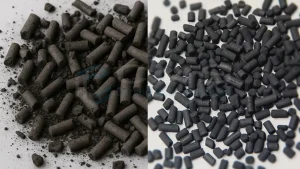
Degradation shows itself in a few recognisable ways. Attrition generates fines, fines migrate, and a bed that has developed channels passes air through without separating it. Purity falls away, pressure drop rises, and dust begins to carry over. Those symptoms are covered in more detail in our notes on ash and dust emission.
Loading the Replacement Bed
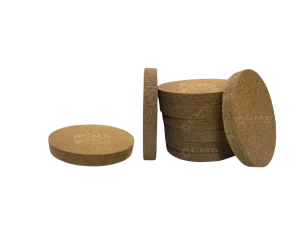
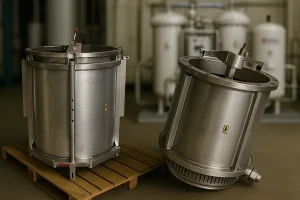
Much of a bed's working life is decided at the moment the vessel is filled rather than during operation. A bed loaded densely and evenly by the snowstorm filling method resists settling and channelling far better than one that was poured in, because the packing is uniform from wall to wall. Holding that packing under load is the function of compression pads, which secure the bed against the vibration normal to a working plant.
Protecting the new bed from oil and moisture carried over from the compressor belongs in the same scope as the fill itself. Our guidance on loading and maintaining CMS covers the practical sequence, and following it is usually the difference between a replacement that lasts and one that disappoints.
Specifying a Refill for an LMC Unit
Tell us which processes run on the nitrogen and the purity each one needs, the flow the plant draws, the compressed air available to it, the vessel dimensions and what is loaded at present. We will match the grade and the bed volume to that duty, and say plainly if the output being asked of the unit was never achievable with the bed it has.
For a refill on an existing LMC unit, or a first fill on a new line, request a technical data sheet or talk the duty through with our team.
Contact US
Related Topics
How to Solve CMS Ash/Dust Emission in PSA Nitrogen Generators?
Compression pads (CFL) for Stabilizing the Carbon Molecular Sieve Bed
Optimize CMS Filling in Nitrogen Generators using Snowstorm Filling
Nitrogen Generation by Pressure Swing Adsorption (PSA)
How Can We Maintain and Load CMS in Nitrogen Generators