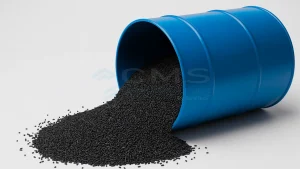
What is Carbon Molecular Sieve?
Carbon Molecular Sieve (CMS) is a microporous carbon adsorbent that separates gases by the rate at which each one enters its pores, rather than by how strongly each is held. In PSA Nitrogen Generation, CMS fills the vessels and selectively adsorbs oxygen from compressed air while nitrogen passes through as the product gas.
CMS differs from standard activated carbon because its pore entrances are engineered to enable very selective gas separation. Therefore, CMS is widely used in onsite nitrogen generation systems where purity, repeatability, and compact system design are important.
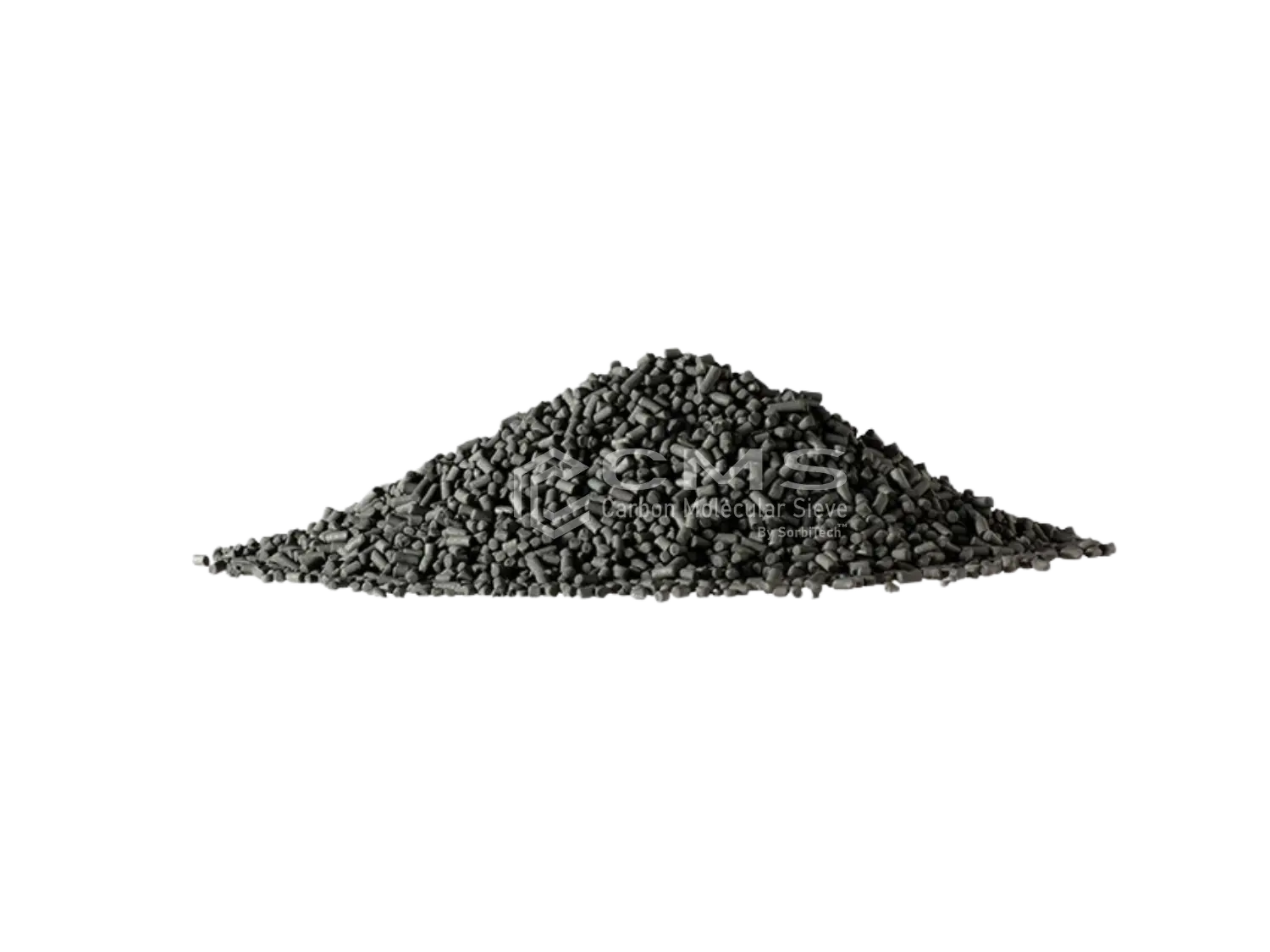
CMS is supplied in several grades and pellet sizes, matched to nitrogen purity targets, flow rates, vessel dimensions and operating conditions. Which grade suits a system depends on the generator design and the nitrogen specification it has to meet.
Working Principle: How CMS Separates Nitrogen From Air
A PSA nitrogen generator uses compressed air as the feed gas. The air first passes through pretreatment, minimizing oil, water, and contaminants before entering the CMS bed. The clean compressed air then enters a vessel filled with the adsorbent. CMS adsorbs oxygen under pressure and allows nitrogen to pass through as the product gas. When the bed nears saturation, the vessel depressurizes, releases the trapped gases, and prepares the CMS for the next cycle. A second vessel continues production while the first regenerates.
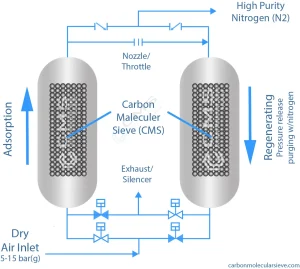
What the cycle above does not explain is why the carbon separates the two gases at all, and this is where the microporous carbon departs from an ordinary adsorbent. The separation does not rely on oxygen being held more strongly than nitrogen. It relies on how quickly each molecule can enter the pore. Oxygen has a kinetic diameter of 0.346 nm and nitrogen 0.364 nm, a difference of roughly 0.018 nm, and the pore size of the slit shaped micropore openings in CMS is engineered to fall within that narrow window, broadly in the region of 0.3 to 0.5 nm. Because the pore mouth is dimensionally close to both molecules, oxygen passes through and fills the internal micropore volume far faster than nitrogen, even though both gases would approach a similar loading if the bed were left indefinitely.

This is why the mechanism is described as kinetic, or rate based, separation rather than equilibrium separation, and it is the single most important idea in understanding CMS. The adsorption step is stopped deliberately after a short interval, long enough for oxygen to be taken up but too short for nitrogen to follow it into the pore. Nitrogen therefore travels through the bed and leaves as product gas while oxygen stays trapped inside the carbon. Every aspect of the generator economics follows from that timing. If the step runs too long, nitrogen begins to enter the micropores and purity falls. If it is cut too short, the bed is regenerated before its capacity has been used and productivity drops.

The PSA Cycle, Step by Step
A PSA nitrogen generator runs two vessels through a repeating sequence. One vessel is always producing while the other is recovering, which is what makes the nitrogen supply continuous rather than batched.
- Air preparation. Compressed air is dried and stripped of oil and particulates before it reaches the bed. Moisture and oil that get past this stage do not leave again, and they block the pore mouths the separation depends on.
- Adsorption. Prepared air enters the online vessel under pressure. Oxygen diffuses into the micropore structure quickly while nitrogen largely stays in the gas phase, so the gas leaving the outlet is nitrogen rich. This is the step the whole design exists to serve.
- Pressure equalisation. Before the vessels swap duty, gas is transferred from the vessel that has finished producing into the one about to start. This recovers energy that would otherwise be vented and steadies the pressure the next adsorption step begins at.
- Blowdown. The offline vessel is vented. As pressure falls, the oxygen held in the pore network is released, because kinetic adsorption is reversible and driven by pressure.
- Purge and regeneration. A portion of product nitrogen is passed back through the offline vessel to sweep out the desorbed oxygen, returning the bed to a clean starting condition.
- Repressurisation and switch. The regenerated vessel is brought back up to working pressure and the valves swap the duty. The sequence then repeats.
Two things decide how well this sequence performs in practice. The first is the consistency of the pore size distribution, because the separation is a race between oxygen and nitrogen and that race is set by the pore openings. The second is bed loading, because a bed with voids or channels lets air bypass the mass transfer zone and reach the outlet untreated.
Why CMS Is Used for PSA Nitrogen Generation
Nitrogen is produced at industrial scale by three routes, and each one wins in a different place. Which one suits a plant is decided by the demand profile, not by an abstract ranking.
| Route | What it separates on | Where it fits | Where it works against you |
|---|---|---|---|
| Cryogenic distillation | Difference in boiling point at low temperature | Very large, steady demand, and where liquid product or the highest purities are needed | Demand is modest or intermittent, because the economics rely on the plant running loaded |
| PSA with CMS | Difference in the rate oxygen and nitrogen enter the pore | Onsite supply at small to mid scale, where purity is set by the user and demand varies through the day | The purity target approaches cryogenic territory, because nitrogen recovery falls away as the target tightens |
| Membrane | Difference in permeation rate through a polymer fibre | Lower flows and modest purity, where simplicity and the absence of moving parts matter most | Purity has to be high, because lifting it consumes a large share of the feed air |
CMS sits in the middle of that range deliberately. It puts the purity setting on the operator panel rather than in a supply contract, and it works from compressed air a plant usually already has. The cost of that flexibility is that purity and recovery pull against each other, which is why the grade and the cycle have to be matched to the duty rather than chosen from a catalogue.
Carbon Molecular Sieve Properties and Key Features
Four properties decide how a carbon molecular sieve behaves in service. What makes them worth understanding is that each one fails in a different way, so the symptom on the plant usually tells you which property has moved.
| Property | What it governs | How it shows up when it drifts |
|---|---|---|
| Consistency of the pore opening | The kinetic distinction between oxygen and nitrogen, and so the selectivity itself | Purity falls at the cycle time the generator was commissioned on. Retuning to hold purity then costs productivity instead |
| Kinetic selectivity | How much nitrogen is recovered from a given quantity of feed air | Recovery drops, so the compressor runs longer for the same product and energy per unit of nitrogen climbs |
| Mechanical strength of the pellet | How the bed survives repeated pressurisation and depressurisation | Fines form and migrate. Pressure drop across the bed climbs, and dust reaches valves and downstream filters |
| Resistance to contamination | Service life under the inlet air the plant actually delivers | Capacity is lost and does not come back, because water and oil are not removed by a normal depressurisation |
The first two are set when the material is made. The second two are governed as much by how the bed is loaded and what reaches it as by the carbon itself, which is why loading method and inlet air treatment belong to the specification rather than to a list of accessories.
CMS Uses and Applications
CMS is most closely associated with PSA nitrogen generation, but the end uses of that nitrogen cover many industries.
Applications and uses of nitrogen generated with CMS
| Industry / Sector | Application | Purpose / Benefit |
|---|---|---|
| Food and Beverage | Modified atmosphere packaging, storage and preservation | Extends shelf life by displacing oxygen from the pack |
| Beverages and Brewing | Purging, counter pressure filling and transfer | Protects flavour and prevents oxidation in the line |
| Electronics and Semiconductor | Blanketing, reflow and controlled atmospheres | Prevents oxidation and moisture damage during manufacture |
| Pharmaceutical | Controlled nitrogen environments for production | Maintains product purity and supports compliance |
| Metal Processing and Laser Cutting | Assist gas and protective furnace atmosphere | Produces oxide free cut edges and reduces scaling |
| Oil and Gas | Blanketing, well operations and inerting | Prevents explosive atmospheres and corrosion |
| Pipelines | Purging and pigging | Removes oxygen before commissioning and maintenance |
| Chemical and Fuel Storage | Tank and reactor blanketing | Keeps the vapour space inert and suppresses ignition |
| Rotating Equipment | Compressor dry gas seals | Provides a clean, continuous seal gas supply |
| Automotive | Tire inflation and component manufacturing | Holds pressure longer and limits oxidation |
Carbon Molecular Sieve Specifications
Because CMS is a kinetic adsorbent, its specification sheet describes the geometry of the carbon rather than a single capacity figure. No one value tells you whether a grade will perform. What matters is how the parameters sit together against the duty of a particular generator, so each figure is worth reading for what it governs rather than for what a grade is guaranteed to deliver.
| Specification | What it governs |
|---|---|
| Grade | The overall balance struck between nitrogen purity and productivity. Supplied as CMS 260L, CMS 350KT, CMS 420KT and CMS 450HP, each positioned for a different duty |
| Pore size (opening) | How wide the pore mouth is left, which is the figure the whole separation rests on |
| Pellet diameter | The diffusion path length set against bed pressure drop |
| Surface area | The internal pore surface available for adsorption, which sets the working capacity of the carbon |
| Moisture content | Kept low, because water occupies the same micropores the separation depends on |
| Bulk density | The mass of carbon a given vessel will hold, and so the working capacity of the bed |
Pellet diameter deserves particular attention because it pulls in two directions at once. A smaller pellet shortens the distance a molecule must travel to reach the interior, which sharpens the very kinetic distinction the process depends on, but it also raises the pressure drop across the bed and increases the energy the compressor must supply. A larger pellet reduces pressure drop but lengthens the diffusion path and blunts the separation. The sizes offered across the CMS grades exist so the pellet can be matched to the vessel geometry and cycle time of a particular generator rather than forced into a single compromise.
Moisture content is the specification most often underestimated. Water is adsorbed strongly and occupies the same micropores the separation depends on, and unlike oxygen it is not released during a normal depressurization step. A bed exposed to a failed dryer or to liquid carryover therefore loses working capacity that cycling alone will not recover, which is why the material is supplied dry and why inlet air treatment belongs to the process rather than to the list of accessories. Where contamination has already occurred, the practical consequences are set out in replacing a CMS bed after oil or water contamination.
Published figures for each grade, including pellet size options and nitrogen productivity against purity, are given on the individual grade pages and in the technical data sheet, which is available on request. Because the useful value of any grade depends on the generator it is loaded into, those figures are best read against your own vessel dimensions, cycle time and target purity rather than compared in isolation.
How Carbon Molecular Sieve Is Made
CMS begins as a carbon rich precursor, most commonly coal or coconut shell, which is carbonized at high temperature to drive off volatile matter and leave a rigid carbon skeleton riddled with pores. That skeleton on its own is close to an activated carbon. It has a large internal surface but a pore distribution far too wide to tell oxygen and nitrogen apart, so it would adsorb both gases readily and separate neither.
The step that turns it into a carbon molecular sieve is the deliberate narrowing of the pore mouth. A hydrocarbon vapour is passed over the carbon under controlled conditions and cracked so that a thin layer of carbon deposits at the entrance of each micropore, constricting the opening until it approaches the width of the molecules to be separated. This is the stage at which the 0.018 nm distinction between oxygen and nitrogen is physically engineered into the material, and it is why consistency of manufacture matters so much. A pore mouth left slightly too wide admits nitrogen almost as readily as oxygen and the selectivity collapses. One narrowed slightly too far slows oxygen uptake and the generator loses productivity. The tolerance held during this final step, far more than the choice of raw material, is what separates a high performance grade from a commodity one.
How to Select the Right CMS Grade
Grade selection follows an order. Answered in sequence, these five questions narrow the field quickly, and answering them out of order is how systems end up oversized.
- What purity does the process actually need? Not what would be comfortable. Recovery falls steeply as the target tightens, so purity specified above the real requirement is paid for continuously in air and energy for the life of the plant. This is the single most expensive decision on the list.
- What is the flow, and how steady is it? A generator sized on peak demand that spends most of the day part loaded behaves differently from one that runs flat out, and the grade that suits each is not the same.
- What are the vessel dimensions? Bed depth and diameter set the residence time available and the pressure drop the compressor has to overcome. They also decide which pellet size is sensible.
- What cycle time is the generator built around? The adsorption step has to be long enough for oxygen uptake and short enough to stop before nitrogen follows. A grade suited to a fast cycle is not the one for a slow cycle.
- What does the inlet air treatment really deliver? Not the design case, the condition on a humid day with a dryer that has been in service a while. Grade choice cannot compensate for water and oil reaching the bed.
SorbiTech™ supplies four grades so these answers can be matched rather than compromised. Where the answers sit determines which grade is appropriate, and the individual CMS grade pages set out what each one is built for.
Send your nitrogen purity target, your flow rate and the vessel details, and you receive a grade recommendation with the reasoning behind it. Every grade is produced under ISO 9001:2015 quality management, and engineering support covers loading method and bed support as well as the grade itself.
Contact US
Related Topics
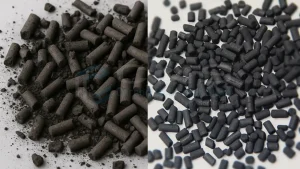
How to Solve CMS Ash/Dust Emission in PSA Nitrogen Generators?
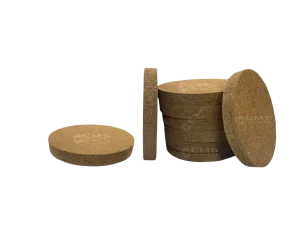
Compression pads (CFL) for Stabilizing the Carbon Molecular Sieve Bed
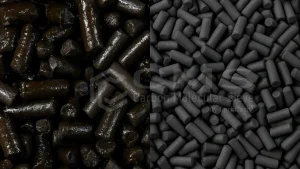
How to Replace a CMS Bed After Oil or Water Contamination?
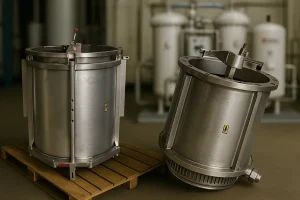
Optimize CMS Filling in Nitrogen Generators using Snowstorm Filling
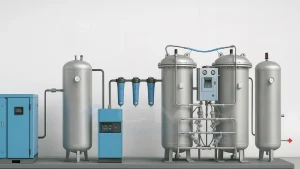
Nitrogen Generation by Pressure Swing Adsorption (PSA)